The Anatomy of a Haniwa Vanilla_Enthusiast!AdF3bWaDQs 2026/09/17 (Thu) 11:36
No. 3411
▼
File
17896450013.jpg
- (80.33KB,
720x706,
Illustration of the Sculptor Goddess-Keiki Haniyas.jpg)

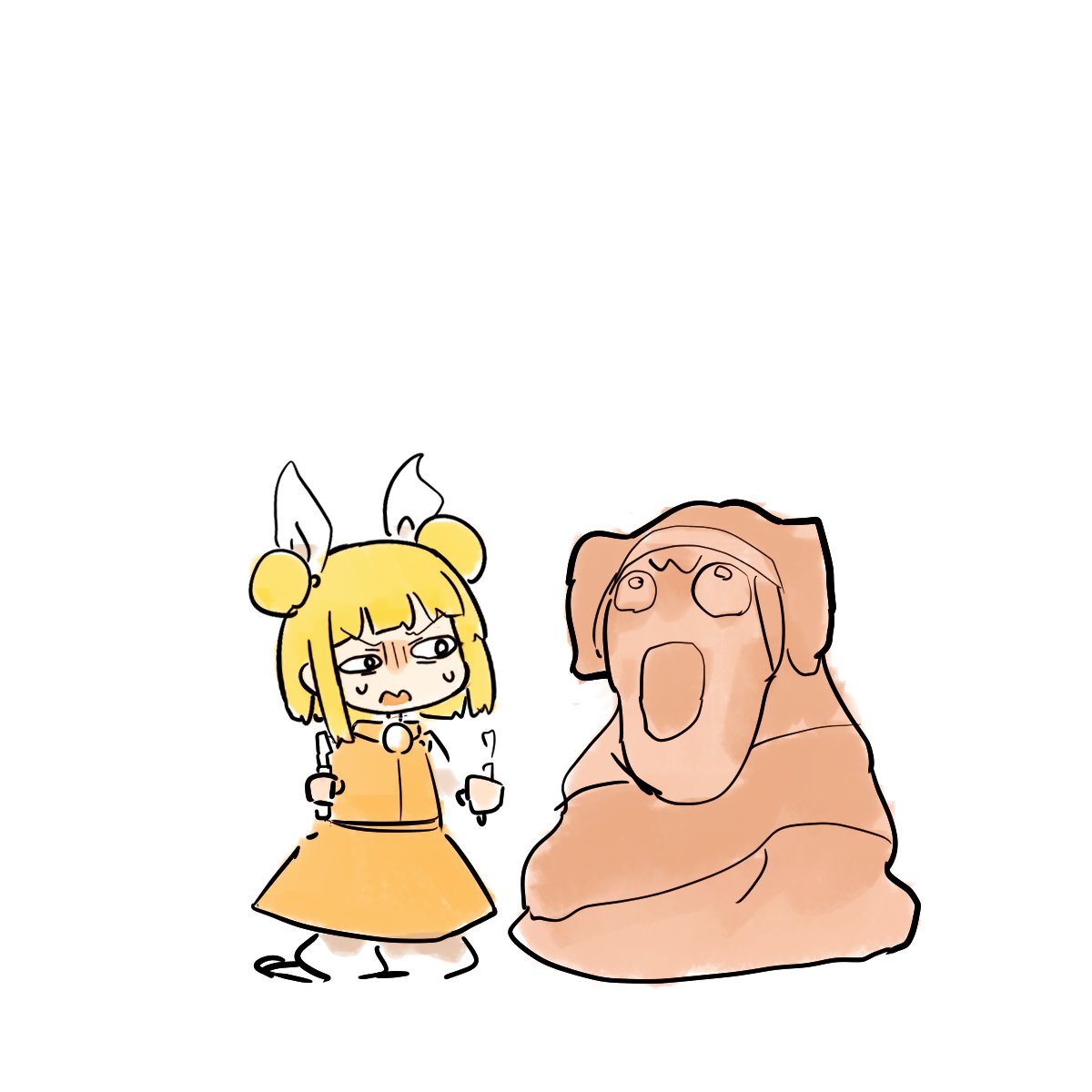
It has been the author's intention to reduce the burden of other curious people trying to study the fascinating complexity of a haniwa, and to achieve this, we aimed to shorten the text to about a third of the length found in standard texts. The shortening was to be achieved by brevity, the omission of repetition, and by the very extensive use of simple illustrations in the belief that ‘a little picture is worth a million words.’ Much repetition has indeed been avoided, and the book is little less than half the length of its original scripture.
It is doubtful, however, if the pictures intended to ease said burden are enough to provide a complete understanding of the anatomy of a haniwa, as its simplicity may have excluded some important details, and opting to use more detailed illustrations would not only cost more, but may also deter other enthusiastic researchers trying to grasp the concept. It is a general criticism of the book. The picture illustrating the neuromuscular control of the pupil of a warrior haniwa is itself necessarily complex, rivaling the Gensokyo map in complexity and is on too small a scale to allow easy understanding or even recognition of its parts.
It is unlikely that such figures as this will lighten any person’s burden in their pursuit to study a haniwa, although careful study of them, if sufficiently prolonged, will be worth while.
Vanilla_Enthusiast!AdF3bWaDQs 2026/09/17 (Thu) 11:50
No. 3413
▼
General Introduction
The term anatomy is a consideration of various structures which make up an organism. A haniwa’s anatomy, just like human anatomy, is predicated on the idea that the body has a clinically insightful story to tell. It is clear that their anatomy is mostly inspired, if not copied, from humans. Just as humans have evolved, haniwa’s design has also evolved over time to further improve their performance. There are two main categories for their model, one from the old times of war where the Sculptor Goddess is still experimenting with their design, and one from the more recent times where the Goddess had (almost) conquered the Animal Realm and further improved their design.
As said above, the framework of haniwa is mostly similar to the human skeleton. The vertebrae of a haniwa are divided into four different regions, being the cervical spine, thoracic spine, lumbar spine, and the sacrum. In haniwa, it is composed of 29 vertebrae that include 7 cervical, 12 thoracic, 5 lumbar, and 5 sacral. As opposed to humans, however, a haniwa’s spine does not include the coccyx region, as their goddess had deemed that having a tailbone on a creature with no tail would be unnecessary.
Another main distinction of their anatomy is that they do not have a central nervous system. Unlike a human’s nervous system, a haniwa does not possess a brain, as their whole nervous system is spread across their whole body through interconnected threads. These threads act as both their muscles and their nerves, so it would be more appropriate to refer to them as one singular system known as the “neuromuscular system”. Because of this, they are capable of functioning normally even after losing 2/3 of their head from a vigorous battle. Do note that most of these threads are still interconnected to the head, specifically the neck, so cutting their heads off completely can still incapacitate them to a degree.
There are two types of strings used for their neuromuscular system, each string designed to fit the haniwa's purpose. Haniwa with the purpose of storing and generating ideas used glass fibers, as their sensitivity makes them more receptive to stimuli, allowing them to learn and adapt faster with each new piece of information they get. Haniwa that are designed for battles are created with hard, sturdy, and flexible strings such as aramid fibers. This allows their body to withstand massive amount of pressure, giving them more strength than a regular haniwa.
Anonymous 2026/09/17 (Thu) 12:20
No. 3414
▼
File
178964763624.jpg
- (74.80KB,
1200x1200,
811dd22ad1a677b7cc78d1b3722dc235.jpg)
Who else reading this for the first time the night before the exam
Vanilla_Enthusiast!AdF3bWaDQs 2026/09/17 (Thu) 23:10
No. 3415
▼
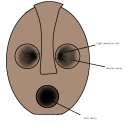
Visual system
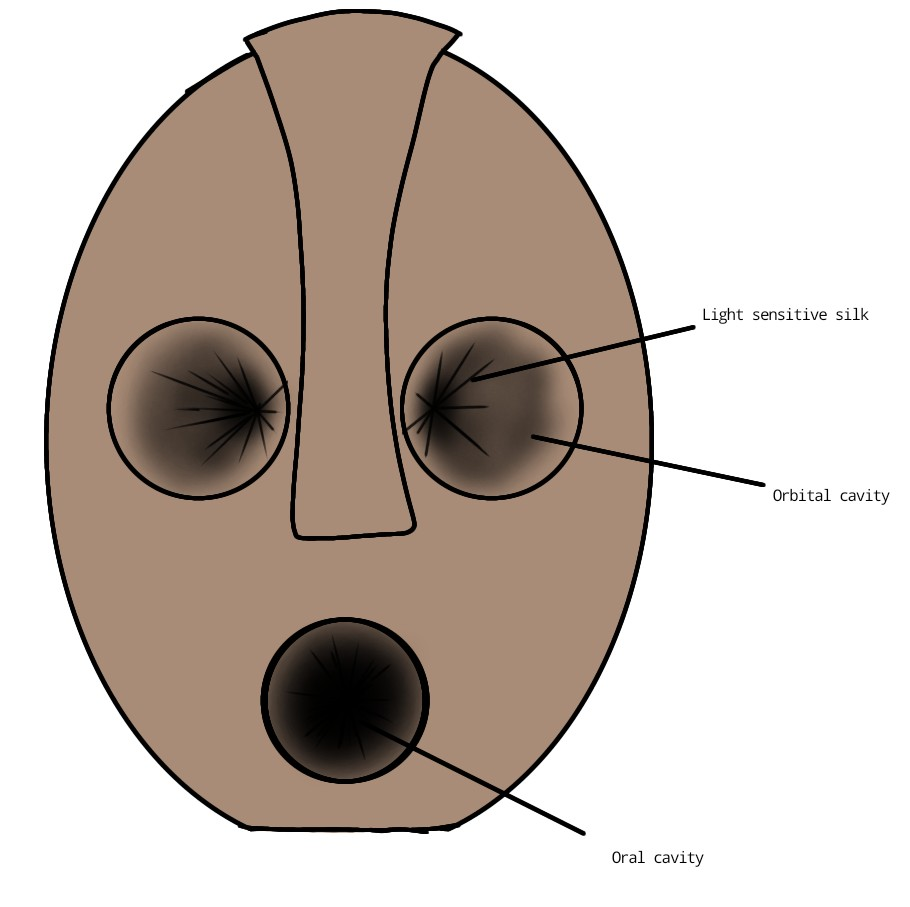
Their visual system is directly connected to their neuromuscular system. The inner layer of a haniwa’s cranium is covered with thin, photosensitive silks (Figure 1). These silks work as a sensor that triggers upon the slightest contact of light. Once triggered, the silks send a signal throughout the whole thread system, allowing their body to conjure spontaneous motoric responses.
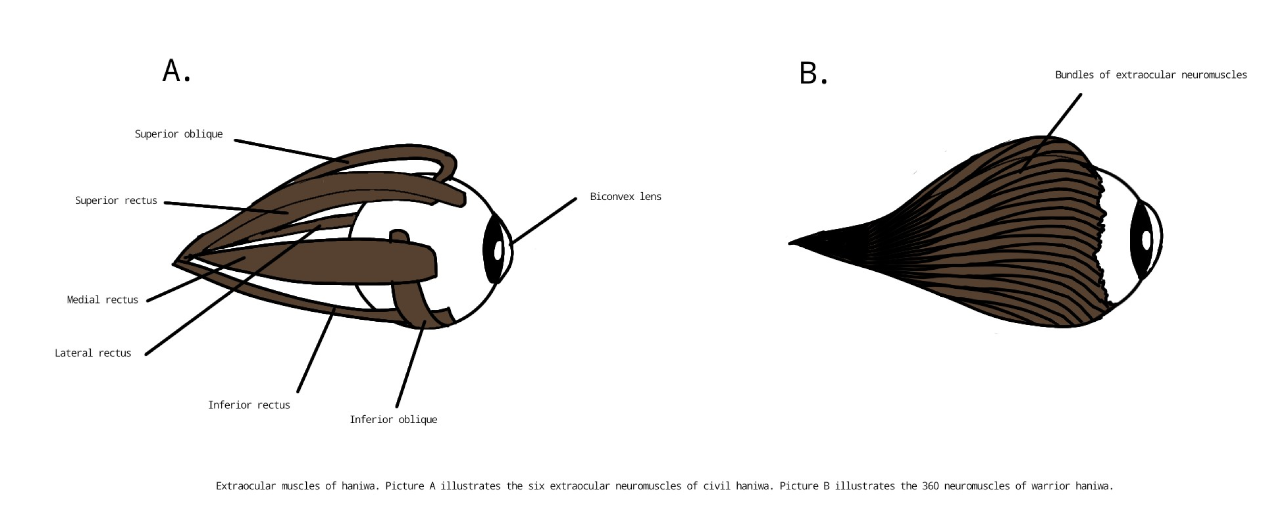
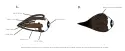
Recent haniwa models have a biconvex lens in their orbital cavity with the mean thickness of 5.0 mm. Their ocular globes are made of transparent glass measuring approximately 22 to 27 mm in anteroposterior diameter and 69 to 85 mm in circumference. The ocular control of newer haniwa consists of a similar mechanism with the six extraocular muscles of a human, including four rectus muscles (lateral, medial, superior, inferior) and two oblique muscles (superior, inferior). However, on certain types of haniwa that was expected to be in prolonged fighting conditions, such as the haniwa warriors and the ex-head of the Haniwa Army, Mayumi Joutouguu, the numbers of the ocular muscles is exponentially increased, giving one neuromuscles for each angle of the eye, reaching up to 360 neuromuscles (Figure 2). The purpose of this is to give warrior haniwa a complete and utter mastery of their vision, allowing them to catch up with complex danmaku patterns that are common in the Animal Realm.
Vanilla_Enthusiast!AdF3bWaDQs 2026/09/18 (Fri) 23:56
No. 3416
▼
File
178977577484.webp
- (104.95KB,
1280x521,
Figure 2-Extraocular muscles of new models.webp)
Auditory system
The auditory system governs the detection and interpretation of environmental sound. The auditory system of older models are mostly similar to their visual system. The sensitive silks capture particle motions within the air. Sound waves enter their orbital and oral cavity and make contact with the silk, initiating vibration that would then be interpreted as signals.
It is a different case for the newer models, however. Their auditory system are closer to their reference. Their outer ears are made of flexible earthenware clay to capture sound waves more effectively. Upon reaching the inner ear, the vibration would enter a shell-like structure called the cochlea. Haniwa’s cochlea contains thousands of tiny silks that act both as motional sensors and as motional actuators. The feedback gained from the soundwaves gives them more detailed informations such as the distance of the origin of the sound and the direction they are coming from.
Anonymous 2026/09/20 (Sun) 04:01
No. 3421
▼
...Friend, you paired the image of their eyes with the article on their hearing.
Anonymous 2026/09/20 (Sun) 12:20
No. 3422
▼
>>3421
Haniwa hear through their eyes and see through their hair buns.
Don't you know anything?
Vanilla_Enthusiast!AdF3bWaDQs 2026/09/20 (Sun) 12:52
No. 3423
▼
File
178990877883.webp
- (111.06KB,
768x606,
Figure 3-Integument segments on newer models.webp)
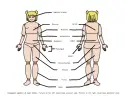
Integumentary system
The integumentary system is the largest organ of the human body. This is untrue for a haniwa. Unlike most living creatures, the integument of a haniwa is divided into segments, parting at the joints to make space for them to work correctly. Because of this, there are tiny visible gaps between each region of their body. The skin of haniwa is usually made of porcelain, providing physical cushioning to any mechanical trauma and reducing injury to their neuromuscular threads. The hard body gives them additional strength while the smooth surface of porcelain adds a sense of aestheticism. In some cases, they use harder materials such as polymer clay to further amplify their strength.
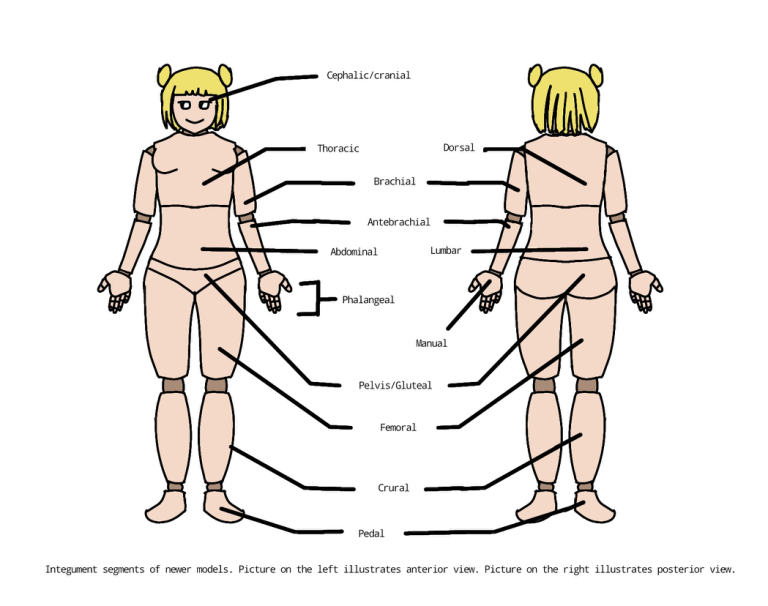
The integumentary system of haniwa is segmented, consisting of 46 segments including cephalic, thoracic, dorsal, 2 brachial, 2 antebrachial, abdominal, lumbar, 2 manual, 28 phalangeal (14 each hand), pelvis, 2 femoral, 2 crural, and 2 pedal (though their feet did not get as much details given to their hands, even on newer models) (Figure 3). Haniwa, despite having a pelvic region, does not have a reproductive system, so there is currently no known reason for this region to exist, and the Sculptor Goddess has dismissed any of our questions regarding this topic.
Besides protection, the integumentary system also performs other essential functions such as temperature regulation and, to a small degree, sensation. Despite not having glands to excrete sweat, porcelain is a good thermal insulator. The lack of sensory receptors in their skin such as Meissner’s corpuscles, Ruffini endings, Pacinian corpuscles, and Krause end bulbs renders them incapable of detecting light touch, warmth, transient pressure, and cold in that respective order. This means that they can only perceive pressure when the damage has already reached their neuromuscles. This limitation does come with benefits, as it means that a haniwa will never be tired from labor or be too injured to fight.
"Thank you for the feedback!" -Marketing Team Vanilla_Enthusiast!AdF3bWaDQs 2026/09/20 (Sun) 12:59
No. 3424
▼

>>3421
The authors never intended to put an illustration for the auditory system and opted to put figure 2-which was meant to be put in the visual system section-in the auditory system as to not overload the readers upon reading. However, we have realized that it might have caused some confusion, and we deeply apologize for that. Your feedback was much appreciated and we will make sure to put ensuing illustrations in their appropriate section to further improve the quality of future entries.
Anonymous 2026/09/21 (Mon) 15:03
No. 3425
▼

>(though their feet did not get as much details given to their hands, even on newer models)
tfw can't suck Mayumi's porcelain toes clean after a hard day on the frontline
> Haniwa, despite having a pelvic region, does not have a reproductive system, so there is currently no known reason for this region to exist, and the Sculptor Goddess has dismissed any of our questions regarding this topic.
The animal realm isn't ready for the Haniwa sex update (also 'does not' should be 'do not')
> This limitation does come with benefits, as it means that a haniwa will never be tired from labor or be too injured to fight.
How does having none of the previously mentioned organs mean that haniwa won't be too injured to fight or be tired from labor? Being too injured to fight would be linked to pain (which would mean lack of nocioceptors, or that Haniwa have a different pain response system), or grievous injury (e.g. amputations) which can't really be mitigated. Being too tired would mean a buildup of lactic acid in the muscles, to my knowledge, so do Haniwa have a different musculatory system to humans?
"We're very sorry!" -Research Team Vanilla_Enthusiast!AdF3bWaDQs 2026/09/23 (Wed) 13:02
No. 3426
▼

>>3425
> How does having none of the previously mentioned organs mean that haniwa won't be too injured to fight or be tired from labor?
Haniwa do not sense pain in the same way humans do. When a neuromuscular trauma occurs, the threads transmit a signal to the rest of the system, notifying them about the damage. Since haniwa do not have sensory receptors (including nociceptors), the sense of pain isn't memorized, sparing them from the mental burden and allowing them to keep fighting until the body falls apart.
Haniwa's fiber muscles are generally stronger and less likely to tear than the average human muscle, so Keiki didn't integrate any limiter system within their neuromuscular system. We admit that the wording in the article seems to be outright misleading and upon further investigation, we have found the culprit responsible for the mistake and effectively fired the individual from our research team to ensure the quality of our entries.
> grammar mistake
It appears that none of the authors speak native english and have been relying on a kappa-engineered device to translate our texts, so linguistic mistakes as such are bound to happen.
In all seriousness, I'm pretty happy that someone took the time to read my stuff seriously. I'm planning to write one more article before finally concluding this story, but production will have to cease for a while due to irl stuff. Feel free to ask more questions though.